Immaculee Ilibagiza

I hear the killers call my name.  They were on the other side of the wall, and less than an inch of plaster and wood seperated us.  Their voices were cold, hard, and determined.  “She’s here…..we know she’s here somewhere….Find her – find Immaculee.  There were many voices, many killers.  I could see them in my mind;  my former friends and neighbors who had always greeted me with love and kindness, moving through the house carrying spears and machetes and calling my name.

“I have killed 399 cockroaches,”  said one of the killers, “Immacul’ee will make 400.  Its a good number to kill.”  I cowered in the corner of our tiny secret bathroom without moving a muscle.  Like the seven other women hiding for their lives with me, I held my breath so that the killers wouldn’t hear me breathing.

Their voices clawed at my flesh.  I felt as if I were lying on a bed of burning coals, like I’d been set on fire.  A sweeping wind of pain engulfed my body; a thousand invisible needles ripped into me.  I never dreamed that fear could cause such agonizing physical anguish.

I tried to swallow, but my throat closed up.  I had no saliva, and my mouth was drier than sand.  I closed my eyes and tried to make myself disappear, but their voices grew louder.  I knew that they would show no mercy, and my mind ecoed with one thought:  if they catch me, they will kill me, if they catch me, they will kill me, if they cvatch me, they will kill me….

The killers were just outside the door, and I knew that at any second they were going to find me.  I wondered what it would feel like when the machete slashed through my skin and cut deep into my bones.  I thought of my brothers and my dear parents, wondering if they were dead or alive and if we would soon be together in heaven.

I put my hands together, clasped my father’s rosary, and silently began to pray:  Oh, please, God, please help me.  Don’t let me die like this, not like this.  Don’t let these killers find me.  You tell us in the Bible that if we ask, we shall receive…..well, God, I am asking.  Please don’t let me die in this bathroom.  Please, God, please, please, please save me! Save me!

The killers moved from the house, and we all began to breathe again.  They were gone, but they would be back many times over the next three months.  I believe that God had spared my life , but I’d learn during the 91 days I spent trembling in fear with seven others in a closet-sized bathroom that being spared is much different from being saved…and this lesson forever changed me.  It is a lesson that, in the midst of mass murder, taught me how to love those who hated and hunted me – and how to forgive those who slaughtered my family.

My name is Immacul’ee Ilibagiza.  This is the story of how I discovered God during one of history’s bloodiest holocausts.

Above is the Introduction to Immacul’ee’s gripping book, Left to Tell.   It is Immacul’ee’s story of survival of the 1994 Rowandan holocaust.  In her introduction she writes; “But I’d learn………that being spared is much different from being saved….and this lesson forever changed me.”

There is no space on earth for which we are totally responsible other than our own inner space.  We alone are responsible for the thoughts we choose to harbor.  She showed us that it is possible to be a loving being through all circumstances and our ability to do just that will determine whether we are “spared” or “saved.”  What good is life just for life’s sake?  Life without inner peace is hardly worth living and that inner peace is totally our responsibility.  What kinds of things have happened to you for which you are willing to give up your inner peace?  When you really contemplate your life you must realize that no one can ever do anything to you that can replace inner eace.  And if that happens, you are allowing that event to become more important to you than your own inner peace.  To be fully alive and happy we must be willing to let go of our petty grievences in favor of living in the space of love.  Don’t ask for love….be love.  And that is exactly what Immacul’ee did.

In the last chapter of Left to Tell, she tells of her return to Rowanda, and her visit to her old home where knelt by the graves of her mom and brother.  She told them how she had survived and about her journey to the United States.  She wept, but this time her tears were a release, not a sorrow.  Then it was time to do what she had come to do.

She travelled to a prison and was greeted by Semana who had been a good friend of her father.  He knew why she had come to see him.  He himself had lost chilren to the genocide.  “Do you want to meet the leader of the gang that killed your mother and brother?,” he asked.  “Yes, sir, I do,” was her response.  Semana went to the prison cell where a man called Felicien was being held.  When she saw him, she recognized him as a successful businessman whose children had been Immacul’ee’s playmates in primary school.  She remembered his voice as one of those who had hunted her.  His dirty clothing hung from his emaciated frame in tatters.  This man had once only dressed in the most expensive of clothing.  His skin was now sallow, bruised and broken.  Semana yelled at Felicien..”What do you have to say to her?  What do you have to say to Immacul’ee?”

The book continues, “Felicien was sobing.  I could feel his shame.  He looked up at me for only a moment, but our eyes met.  I reached out, touched his hands lightly, and quietly said what I’d come to say.   I forgive you.  My heart eased immediately, and I saw the tension release in Felicien’s shoulders before  Semana pushed him out the door and into the courtyard.  Two soldiers yanked Felicien up by his armpits and dragged him back toward his cell.  When Semana returned, he was furious.”

“What was that all about, Immacul’ee?  That was the man who murdered your family.  I brought him to you to question….to spit on if you wanted to.  But you forgave him!  How could you do that?  Why did you forgive him?  I answered him with the truth:  “Forgiveness is all I have to offer.”

If you have not read the book, I highly recommend it.  We hear so much about the atrocities taking place in our world, but it is rare to hear of someone who has endured a genocide yet emerged as a beautiful, powerful, loving, fogiving, Divine woman.  This book will renew your faith in God and the undefeatable human spirit.  It will change your mind about the grace found in forgiving anyone for anything.

For now, Earlynn’s just sayin’; “Let’s heal our world one heart at a time.”


Posted in History Tells Us, Self Improvement, Spirituality, Uncategorized | Tagged , , , | Comments Off on Immaculee Ilibagiza

Always Use Two Logs Crossing

A story is told of a young man who went to Alaska.  There he met an old Indian trapper who agreed to teach the young man the skills of a trapper.  The old Indian taught him how to live in the bush, how to lay traps, clean pelts and take care of himself in the wilderness.  When the young man was ready to go out on his own, the wise old Indian gave him this final word of caution: “Remember this,  whatever you do, when you travel, always use two logs crossing.”  He knew his young friend would need to cross many rivers and streams while trapping in the wilderness, so he repeated the advice…..”Always use two logs crossing.”

The young man thoroughly enjoyed himself, trapping throughout the summer.  He had gathered all the furs that he could possibly carry as summer came to its close.   As the leaves  began to turn, he began his journey back to the small town where he could trade his furs.  He hoped to trade his furs for enough money to outfit him for the next spring, plus enough money to live on through the winter.   He did everything right, just as he had been taught, until he came to the last fast-running stream between him and civilization.  He was so anxious to get back to town, he tried to cross the stream using a single log stretched from one bank to the other.

As fate would have it, he lost his footing and fell into the stream.  To avoid drowning he had to throw off his pack.  Everything was lost.  A season’s worth of trapping washed down the stream. When he finally got to the town, wet and exhausted, he met the old Indian.    The Indian looked at him,  shook his head and said, “You forgot to use two logs.”

The moral of the story is when adversity comes, you need to develop alternative choices.  You can never afford to put all your hopes on a single person or a single possibility.  You, too, must use two logs crossing.  Because the young man disregarded his Indian friend’s advice, he lost everything.

Sixty years ago Dale Carnegie outlined a four step method for dealing with adversity.  These four steps are still one of the most powerful mental tools you can use when confronted with any problem or worry:

  1. Define the problem.  What exactly is the problem?  If  more than one problem is troubling you, write out clear definitions of all the problems that constitute what you are worrying about now.
  2. Ask yourself, “What’s the worst thing that can happen in this situation?”  Be honest with yourself.  If everything fell apart, what is the worst thing that could happen?
  3. Accept that the worst may occur.  When you accept that the worst thing may happen, you’ll relax and your mind will clear.  Your ability to deal with the situation will improve greatly.
  4. Don’t worry about what happened or why it happened or who you think is responsible.  What has happened has happened.  Accept that.  Use your mental energy to make a plan for recovery.  Ask yourself, “What can I do now to minimize the consequences?”  What is the first step?  What is the second step and so on.

Always remember you will never have a problem that you cannot handle.  You have within you everything you need to deal with whatever problem may confront you.  Keep your thoughts on where you are going, not where you’ve been.  No matter how difficult a situation may seem,  “This, too, shall pass.”

For now, Earlyn’s just sayin’; “Always use two logs crossing.”

http://earlynnsjustsayin.org/daily-inspirational-thought/

Posted in Self Improvement, Spirituality, Uncategorized | Tagged , , | 1 Comment

WHAT’S LOVE GOT TO DO WITH IT?

Remember the Tina Turner song, What’s Love Got to To With It?  The song is about aspects of what we commonly call love.  The lyrics go on to say, “Who needs a heart when a heart can be broken?”  Is the song describing love or is it lyrically talking about infatuation and/or pleasure seeking?

So, what is the difference between pleasure and love?  Pleasure is always derived from something outside of you, but love arises from within.  Real love will never make you suffer.  Love is your essence and you cannot lose it.  Love, joy, and peace are deep states of Being.  As such they have no opposite.  Whereas, every pleasure or emotional high contains within itself the seed of pain.  As Eckhart Tolle wrote in The Power of Now, “What is often referred to as love may be pleasurable and exciting for a while, but is an addictive clinging and extremely needy condition that can turn into its opposite at the flick of a switch.  Many love relationships, after the initial euphoria has passed, actually oscillate between love and hate, attraction and attack.”  This is because whenever we seek to find love or joy from things or persons outside of ourselves we miss the mark.  To truly love another we must first truly love ourselves.  We cannot give to another what we do not have for ourselves.  I believe the best definition of love was written by the Apostle Paul:

1 Corinthians 13:4-7

Love is patient.  Love is kind.

It does not envy.  It does not boast.

It is not proud.  It does not dishonor others.

It is not self-seeking.  It is not easily angered.

It keeps no record of wrongs.

Love does not delight in evil, But rejoices with truth.

It always protects, always trusts, always hopes, always perseveres.

Love never fails.

For now, Earlynn’s just sayin’, “Love is always the answer.”

http://earlynnsjustsayin.org/daily-inspirational-thought-8/

Posted in Daily Thoughts, Self Improvement, Spirituality, Uncategorized | Tagged , , , , | Comments Off on WHAT’S LOVE GOT TO DO WITH IT?

Dare to Dream

What one great thing would you dare to dream if you knew you could not fail?  Successful men and women are not afraid to dream big dreams.   But many of us have difficulty deciding exactly what we should be doing to fulfill our purpose in life.

Victor Frankel in his book Man’s Search for Meaning said you can divide the things you do in life into four categories:

  1. Things that are hard to learn and hard to do.  For example if you find mathematics hard to learn and hard to do, you clearly are not suited for bookkeeping, accounting, financial statements and tax returns.  No matter how much of it you do, or how good you get at it, you will never achieve lasting satisfaction or happiness from it.
  2. Things that are hard to learn but easy to do.  Things like riding a bicycle, driving a car, and tying your shoes are hard to learn, but easy to do once you’ve mastered them.  These are seldom the sort of activities that cause you to feel great about yourself when you do them because they do not demand your best.
  3. Things that are easy to learn but hard to do.  Digging a ditch with shovel and pick, chopping wood with an ax, and manual labor are all very easy to learn, but very hard to do and they never get any easier.
  4. Things that are easy to learn and easy to do.  These are the things you seem to have a natural ability to do.  You are strongly attracted from the start and you have a strong desire to get better and better. The things that are easy for you to learn and easy for you to do indicate where your natural talents and abilities lie.  When you’re doing these things time seems to fly.  The things that are easy for you to learn and do are the sort of things you should be doing with your life.  These are the activities you are drawn to and you enjoy reading about.  You love talking about it and thinking about it.  You will find yourself admiring people who are outstading in that area.  You will wonder what it is like to be successful doing it.  This is the kind of activity that will give you all the joy, satisfaction and happiness you could want.  This area is probably what you were put on this earth to do.

You were put on earth for a special purpose that will be realized by using your unique set of talents and abilities.  When you harness these talents and abilities and focus your energy on unlocking your true potential you are on the path to true happiness.  As Earl Nightingale said, “Happiness is the progressive realization of a worthy goal.”  Use your unique talents and abilities to set goals for the fulfillment of your potential.   As a result happiness will find you and the world will be blessed in the process.

For now, Earlynn’s just sayin’, “Have the courage to do what you love to do.  Your talents and abilities were given to you for a special purpose.”

http://earlynnsjustsayin.org/daily-inspirational-thought-7/

Posted in Self Improvement, Spirituality, Uncategorized | Tagged , , , | 3 Comments

The Elephant in the Room

Like most citizens of this great country, the United States of America, I am very concerned about the violent killings we have witnessed over the last few years.  Everyone is wringing their hands, trying to figure out what is the cause of this bizarre behavior.  Many  believe guns are the cause.  Many believe violent movies are the cause.  Others believe letting our children play violent video games is the root of the problem.

I believe we can all agree, guns in the hands of unstable individuals is a problem.  We can also agree that  violent movies do not stabalize our young people and certainly violent video games do not teach our young people about peace and unity.   But as we try to solve the problem of violence in our society let’s not ignore the elephant in the room.

I’m referring to the most profitable industry in the world.  This industry’s top ten Fortune 500 companies earn more yearly profits than the remaining 490 Fortune 500 companies combined.  These companies spend millions wining and dining our nation’s doctors and congressmen and spend millions more in advertising through television, newspapers and magazines.  By now you probably know the elephant in the room is named “Big Pharma“.

You have heard the advertisements.  Commercials tell you to ask your doctor if  an advertised drug is right for you.  However, you are instructed to let your doctor know immediately if you have thoughts of suiside or agression especially in children, adolescents, and young adults.  And the drug may cause death or liver failure, ect.  Additionally, the drugs for ADHD, depression and insomnia have warnings they may cause worsening drepression, anxiety, agitation, panic attacks, insomnia, irritability, hostility, aggressiveness, impulsivity, mania, and akathisia.  Imagine people who are depressed being prescribed drugs that clearly state on the bottle that the drug could make them worse and more likely to commit suicide.  That’s insane!

Between 2004 and 2011, the FDA’s Adverse Events Reporting System for drug side effects logged 12,755 reports of psychiatric medications relating to violence.  Among them were 359 homicides, 7,250 incidences of aggression, and 2,795 episodes of mania.  There were also 9,310 suicides.  Actually the damage is far greater because fewer than 10 percent of adverse reactions are reported.  So, multiply these numbers by 10 to get a truer picture of the horrors of these medications.  Certainly “Big Pharma” is aware of these devastating side effects, but they make untold millions of dollars from these drugs.   So it is not likely they will voluntarily stop their production or be involved in looking for effective alternatives.

The Citizens Commission on Human Rights recently published a list of 14 school shootings linked with psychiatric drugs.  The 14 school shootings and 10 murder and murder-suicides listed left a total of 102 dead and 131 wounded.  All were committed by individuals who have been positively identified as having been taking or withdrawing from antidepressants or other psychiatric drugs.  These figures include Aurora and Columbine, Colorado.  These medications are strongly suspected in many other school shootings including Newtown, but we’ll never know for sure.

Under the guise of protection of privacy, the medical records of the individuals who commit these unspeakable acts of violence are often sealed – as if anyone who kills innocent people needs or deserves such privacy.  Dr. Julliam Whitaker writes an excellent newsletter which details the case against psychiatric drugs in his February, 2013 newsletter.

So, the elephant in the room is the prescription drugs being prescribed for those who can least afford the side affects.  Why has this information not been part of the public discussion?   It should be front and center.   We cannot get a handle on the violence affecting our society without including this “Big Pharma” drug problem in the equation.

For now, Earlynn’s just sayin’:  “As we pursue solutions to our nation’s problems with violence, remember, the truth will set us free only if we are wise enough to recognize it when we see it.  We’ve got to start talking about the elephant in the room.”

http://earlynnsjustsayin.org/daily-inspirational-thought-6/


Posted in Health and Wellness, History Tells Us, Self Improvement, What Science Tells Us | Tagged , , , , , , , , , | Comments Off on The Elephant in the Room

Laugher is good medicne

Remember the movie, Singing in the Rain?  One of my favorite characters is portrayed by Donald O’Connor.  He sang and danced through one of the funniest movie scenes of all time.  The song was  Make ’em Laugh:

Though the world is full of a number of things I know we should all be as happy as

But are we?

No!  Definitely no!  Positively no.!  Decidedly no!     Mm mm,

Short people have long faces and long people have short faces.

Big people have little humor and little people have no humor at all!

And in the words of that immortal buddy Samuel J. Snodgrass, as he was about to be led

To the guillotine:

 Make ‘em laugh…make ’em laugh!   Don’t you know everyone wants to laugh?

(Ha ha!)

My dad said  “Be an actor, my son but be a comical one,

They’ll be standing in lines for those old honky tonk monkeyshines!”

 Now you could study Shakespeare and be quite elite,

And you can charm the critics and have nothin’ to eat.

Just slip on a banana peel….the world’s at your feet!

Make ‘em laugh…make ‘em laugh… make ‘em laugh!

 Make ‘em………make ‘em laugh!

Don’t you know everyone wants to laugh?

My grandpa said go out and tell ‘em a joke, but give it plenty of hoke.

 Make ‘em roar…make ‘em scream…take a fall…butt a wall…split a seam.

 You start off by pretending you’re a dancer with grace.

You wiggle’ till they’re giggling all over the place,

And then you get a great big custard pie in the face…..

Make ‘em laugh…make ‘em laugh…make ‘em laugh!

 Make ‘em laugh…make ‘em laugh!  Don’t you know all the world wants to laugh?

My dad said, They’ll be standing in lines for those old honky tonk monkeyshines

 Make ‘em laugh…make ‘em laugh!

 Don’t you know everyone wants to laugh?

 Ah ha ha ha ha ha ha

Ah ha ha ha ha ha

Ah ha ha ha ha ha ha

Ah ha ha ha ha ha ha ha ha

Make ‘em laugh, ah ah!   Make ‘em laugh, ah ah!   Make ‘em laugh, ah ah!

 Make ‘em laugh!  Make ‘em laugh!  Make’em laugh!

The song got me thinking about how important laughter is to our enjoyment of life.  We’ve all heard it said that it takes 43 facial muscles to frown while only 17 muscles to smile.  There is really quite a debate over the number of muscles  needed to either smile or frown, but one thing is certain.  A smile is recognized all over the world as a sign of friendship and peace.

There’s been a lot of study about smiling and laughter.  In fact there’s even a name for the study of laughter…..gelotology.  Laughter begins as an uncontrollable reflex when babies reach about four months.  Is there anything more pleasurable than listening to a baby giggle?  Unfortunately, as children get older they are taught to downplay laughter by parents and teachers who try to emphasize the seriousness of life.  According to the Scientific American; “The attitude seems to be if you’re laughing, you’re not learning.  As a result, educators often neglect humor.  This is a big mistake because students learn better when teachers can present material in an amusing way.  A comic anecdote helps children remember, and an entertaining approach creates a more relaxed, enxiety-free learning atmosphere.”

In a study done by Marquette University, a list of 30 words along with a funny video clip were shown to students.  One week later the students who had been exposed to the video clip remembered 20 percent more words than those who only heard the words.  It is theorized that a good guffaw prepares the brain to retain information.  And laughter is contagious…just hearing laughter primes your brain and readies you to smile and join in the fun.  When laughter is shared, it binds people together and increases happiness and intimacy.    Laughing with friends releases feel-good brain chemicals which also relieve pain.  Also, if you are having trouble with a cross-word puzzle…watch 15 minutes of comedy and you’ll find you can more easily complete the puzzle.

  • Laughter relaxes the whole body.  A good, hearty laugh relieves physical tension and stress, leaving your muscles relaxed for up to 45 minutes afterward.
  • Laughter boosts the immune system.  Laughter decreases stress hormones and increases immune cells and infection-fighting antibodies, thus improving your resistance to disease.
  • Laughter triggers the release of endorphins, the body’s natural feel-good chemicals.  Endorphins promote an overall sense of well-being and can even temporarily relieve pain.
  • Laughter protects the heart.  Laughter improves the function of blood vessels and increases blood flow, which can help protect you against heart attack and other cardiovascular problems.

Have you ever been in a tense situation when suddenly something unexpected happened and everyone broke into laughter completely shifting perspectives?  After a good laugh the tension is gone and new perspectives are more easily entertained.  The ability to laugh and play and have fun with others makes life more enjoyable.  It helps get perspective in problem solving, connects us with others, and helps us  become more creative and healthier.

Descartes said, “To do is to be.”      Sarte said, “To be is to do.”  But Frank Sinatra said, ……….. are you ready?…….”Do be do be do.”

For now, Earlynn’s just sayin’:  “Do be do be do!”   Come on, smile.  You know you want to.

 http://earlynnsjustsayin.org/daily-inspirational-thought-5/


Posted in Health and Wellness, Uncategorized, What Science Tells Us | Tagged , , , , | 1 Comment

EGO

The greatest challenge we face as human beings is the taming of the ego.  This goes for our personal lives as well as collectively around the world.  Our individual world is a microcosm of the world.  When we individually tame our ego, so it will be in the world.  Ego believes in seperation and scarcity.  It does not understand we are one and it preaches scarcity.  Therefore, I am justified in getting what I can at your expense.  The ego loves being right and will go to great lengths to prove it is so.  Because if I am right, someone else is has to be wrong.  That strengthens the ego’s feeling of superiority.  Ego is constantly judging others.

It is said that ego controls our thinking 60 to 80 percent of the time.  It does not understand the benefit of being still and quieting the mind through meditation.  It seeks to keep our mind occupied with constant, repetitive and non-productive chatter.  Eckhart Tolle writes; “Not to be able to stop thinking is a dreadful affliction, but we don’t realize this because everybody is suffering from it, so it is considered normal.”

Many associate so closely with thinking that they mistakenly believe they are their thoughts.  But we are not our thoughts.  Our true essence is our Spirit, or Higher Self.  We experience our Higher Self in silence.  Often we’ve heard and have probably said;  “I can’t turn off my thoughts….they’re driving me crazy.”  It’s then we realize our thoughts are seperate from our Higher Self as thoughts endlessly and aimlessly parade through our mind.  Eckhart Tolle also wrote; “Many people live with a tormentor in their head that continuously attacks and punishes them and drains them of vital energy.  It is the cause of untold misery and unhappiness, as well as of desease.”

In this world of duality we are three aspects in one…..mind, body and spirit.  Our true essence is our soul, or our Higher Self, but the mind is often controlled by our ego.  Our Higher Self is the witness to the thinking of the mind.  Our higher Self longs for peace, love, and stillness.  With practice we can stop the constant thinking long enough to feel the calm peaceful essence of our Higher Self.  True creativity happens when stillness in interspersed with deliberate thought.

If we are to overcome the ego and experience our Higher Self, we need to find time to sit quietly and allow our minds to become still.  Our Higher Self, that spark of divine within longs to be kind, loving, peaceful and supportive.  But at times our ego gets the better of us and we create a false mind-made self that casts a shadow of fear and suffering.  The following quote really touched my heart:

“I came out alone on my way to my trist.  But who is this me in the dark?  I move aside to avoid his presence but I escape him not.  He makes the dust rise from the earth with his swagger; He adds his loud voice to every word I utter.  He is my own little self, my lord, he knows no shame;  But I am ashamed to come to thy door in his company.”  Rabindranath Tagore

For now, Earlynn’s just sayin’  “I pray we have the courage to let our Higher Self be in control always and in all ways.  The whole world benefits when we individually tune in to our Higher Self.”

http://earlynnsjustsayin.org/daily-inspirational-thoughts/


Posted in Health and Wellness, Self Improvement, Spirituality | Tagged , , , | Comments Off on EGO

Rest in Peace, “I Can’t”

I recently read a story written by Chick Moorman.  Mr. Moorman had organized a county-wide staff development project focused on language arts to empower students to feel good about themselves and take charge of their lives.  Donna was a teacher only two years away from retirement who was a volunteer participant in Mr. Moorman’s project.

Part of Mr. Moorman’s routine was to make classroon visits and encourage implementation of ideas from the project.  As he took a seat at the back of Donna’s classroom, he felt an undercurrent of excitement.  The students were busy writing on their  papers.   He noticed the ten year old student closest to him was filling her page with I Can’ts.   I can’t——-, I can’t——-, I can’t————.  Her page was half full and she showed no sign of slowing down.  He walked down the row glancing at the students’ papers.  Everyone was writing sentences about things they couldn’t do.

I can’t do 10 push-ups, I can’t hit one over the left field fence, I can’t eat only one cookie, I can’t get Debbie to like me, I can’t do long division with more than three numbers, I can’t, I can’t , I can’t.

He walked by to see what Donna was writing.  She, too was busy writing; I can’t get John’s mother to come in for a teacher conference,  I can’t get my daughter to put gas in the car,  I can’t get Alan to use words instead of fists.

Why is she encouraging these boys and girls to focus on negative thoughts?  Why is Donna not asking for positive “I Can” statements?  He decided to hold off his judgments and return to his seat to continue observing the class.  They wrote for another ten minutes.  Finally Donna said, “Students, finish the one you’re on  and don’t start a new one.  When you’re finished fold your papers in half and bring them to the front.  Put your I Can’t statements into this empty shoe box.”

When the students had all placed their papers in the box, Donna added hers.  She put the lid on the box, tucked it under her arm, and headed out the door. “Follow me,” she said.  Halfway down the hall she entered the custodian’s room and came out with a shovel.  With a shovel in one hand and the shoe box in the other, Donna marched the students out to the farthest corner of the  playground.  There they began digging a hole big enough to bury their I Can’ts.  The boys and girls took turns with the shovel.  When the hole was about three feet deep, the digging ended.  The box of I Can’ts was placed at the bottom of the hole and quickly covered with dirt.

Thirty One fourth grade boys and girls stood around the grave site.  All including Donna had placed at least one page in the now burried box of  I Can’ts.  Donna asked the children to join hands and bow their heads.  They formed a circle around the grave, creating a bond with their hands.  They bowed their heads while Donna delivered the eulogy: “Friends, we gather today to honor the memory of  I Can’t.  While he was with us on earth, he touched the lives of everyone, some more than others.  His name, unfortunately has been spoken in every public building – schools, city halls, state capitols and yes, even the White House.  We have proivided I Can’t with a final resting place and a headstone that contains his epitaph.  He is survived by his brothers and sister, ‘I Can’, ‘I Will’, and ‘I’m Going to Right Away’.  They are not as well known as their famous relative and are  certainly not as strong and poweful yet.  Perhaps someday, with your help, they will make an even bigger mark on the world.  May I Can’t rest in peace and may everyone present pick up their lives and move forward in his absence.  Amen.”

At the conclusion of the eulogy Donna turned the students around and marched them back to the classroom where they held a wake.  They celebrated with cookies, popcorn and fruit juices.  Donna made a large tumbstone from butcher paper with the words I Can’t at the top and RIP in the middle.  The date was added to the bottom.  From that date on, the paper tumbstone hung in Donna’s classroom.  On those rare occasions when a student forgot and said, I Can’t, Donna simply pointed out the RIP sign and the student would rephrase the statement.  Donna’s students learned a great metaphor for life.  The experience would stick in their minds forever.  As for Mr. Moorman, he writes:  “Now years later, whenever I hear the phrase, I Can’t, I see images of that fourth-grade funeral.  Like the students, I remember that I Can’t is dead.

For now, Earlynn’s just sayin’:  “Next time you catch yourself saying I Can’t, rephrase and say;  “I Will, I Can, or I’m going to right away.”

http://earlynnsjustsayin.org/daily-inspirational-thought-4/


Posted in Self Improvement | Tagged , , , , , | 1 Comment

Hidden in Plain Sight

Buddhist monks from the kingdon of Ayutthaya, Siam, were responsible for the care of a very rare and vauable 10′ tall statue of Buddha.  The statue is generally believed to have been cast in India during the 13th or 14th century.  The monks cared for and protected the statue during the period from about 1404 to 1767.  In 1767 the monks became worried that their kingdom would be over-run and destroyed.  They also knew if that were to happen, the statue would be plundered by the Burmese invaders.  So it was decided to cover the statue with a thick 8″ layer of stucco.  To beautify it somewhat, small bits of colored glass were imbedded.  Their aim was to make the statue look unimpressive and ordinary.  They believed their precious statue would be preserved if it were hidden in plain sight.  They were right.  Although the Bermese slaughtered all of the monks, the statue remained among the ruins of Ayutthaya without attracting much attention for 34 years.

In 1801, the King Buddha Yodfa Chulaloke, (Rama I) established Bangkok as the capital city of the kingdom now known as Thailand.  He commissioned the construction of many temples in the new capital city and put out an order that various old Buddha images be brought to Bangkok from the ruined temples around the country, so the stucco Buddha was brought to Bangkok.

Sometime between 1824 and 1851 during the rule of King Rama III, the statue was installed as the principal Buddha image in the main temple building of
Wat Chotanaram in Bangkok.  Eventually Wat Chotanaram fell into disrepair and in 1935 the statue was taken a short distance to Wat Traimit.  Since the temple didn’t have a building big enough to house the statue, it was kept under a simple tin roof for 20 years.

In 1955, it was decided to move the stucco Buddha one more time to a new building at the temple.  As rain came pouring down, the statue weighing over 5 tons was being lifted off its pedestal.  Suddenly, the ropes bearing the weight of the statue broke and the statue fell with tremendous force to the ground causing a crack to appear.  The head monk being very concerned covered the statue with a tarp.  Later that evening he went to check on the Buddha to make sure it remained dry.  When he shined his flashlight under the tarp, he noticed a little gleam shining through the crack.  As he took a closer look at this gleam of light, he wondered if there might be something hidden beneath the stucco. He went to the monastary to get a chisel and hammer and began to chip away at the stucco.  As he knocked of chards of stucco, the little gleam grew brighter and bigger.

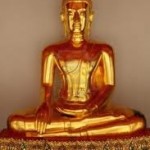
Later, all of the stucco was carefully removed revealing the solid gold Buddha.  The Ayutthayain monks had succeeded in hiding the statue in plain sight for almost 200 years!  The estimated value at today’s gold prices is over $303,000,000.00.  In 2010, a large and beautifully ornate building was inaugurated at the Wat Traimit Temple to house the Golden Buddha.  See picture below.

Jack Canfield says this about the Golden Buddha: “We are like the clay Buddha covered with a shell of hardness created out of fear, and yet underneath each of us is a ‘golden Buddha.’ a ‘golden Christ,’ or a ‘golden essence,’ which is our real self.  Somewhere along the way, between the ages of two and nine, we begin to cover up our ‘golden essence,’ our natural self.  Much like the monk with the hammer and chisel, our task now is to discover our true essence again.”

For now, Earlynn’s just sayin’:  “Have you begun your discovery of your true essence, your ‘golden essence” within?”

2 golden BuddhaHome of Golden Buddha

http://earlynnsjustsayin.org/daily-inspirational-thought-3/


Posted in History, Self Improvement, Spirituality | Tagged , , | Comments Off on Hidden in Plain Sight

Water, Water, Nothing Else Will Do

If you’re like me, you have been taught that you need to drink at least 8 glasses of water daily to maintain optimum health.  We’ve also been taught that if we drink caffeine, we should drink extra water since caffeine is  a diuretic.  We all know we need to drink those 8 glasses of water, but how many of us really do that?  I believe we don’t delilberately do things that are detremental, but why do we neglect drinking those eight glasses of water every day?  The problem, as I see it, is that we don’t really understand why it is so important.  Because if we really believe our good health is dependant on keeping ourselves hydrated, we’d be doing it, wouldn’t we?  Well, let me tell you a story.

In 1979, just prior to the revolution in Iran (Persia) that ended 2500 years of continuous monarchy; a man by the name of F.Batmanghelidj was a wealthy and prominent physician in Tehran.  He was busily engaged in the completion of a family charity medical center, the largest medical complex in Iran.  During the revolution The Shah of Iran was forced to seek amnesty in Egypt.  Revolutionists intent on ridding the country of those associated in any way with The Shah were arresting “enemies of the people”, executing them and/or throwing them in prison to await “Mock” trials.  Revolutionary guards took Dr. Batmanghelidj to Evin Prison.  The doctor’s impending trial was announced on television several times a day for many days with appropriate revolutionary slogans.

The outcome was predetermined:  death.  The doctor had done nothing wrong except being associated with the “establishment” in buildig hospitals, medical centers and such.  He had no idea if he was going to survive as he watched guards pluck 20 – 30 – up to 100 men out of the crowd and take them out and shoot them.  He along with 8,000 to 9,000 prisoners was jammed into a prison intended to house 600.  Rooms designed to hold four to six persons were packed with 90 people.  One third of the prisoners stood, while another third sat while the other third lay down in eight hour shifts.  If the stress of civilized life at its worst is a 15 on a scale of one to ten, the stress for these prisoners was 100.

These prisoners were not vicious thugs accustomed to prison.  These were beautiful men and women – educators, doctors, and scientists.  Their only crime was that they were perceived as being part of the “evil” establishment.  Dr. Batmanghelidj came from a wealthy family of dedicated doctors and scientists.  He was a trained scientist and medical doctor who loved his country and his profession.

The doctor recalls; “I had just come into the main block.  It was eleven P.M. on a January night in 1980.  A man was carried in by two other people.  He was a pepic ulcer patient in such terrible pain he could not walk.  He wanted to go to the hospital, but they wouldn’t take him.  He asked for medication, but I had none.  But I felt water would relieve his pain.  I gave him two glasses of water and his ulcer pain disappeared within eight minutes.  Then I put him on two glasses of water every three hours.  I remembered that when I was a medical student, I used to drink water whenever I had heartburn, and it cured it.”

After treating many more cases, he saw another unforgettable case.  A young man in the cell block was in such pain that he was almost semiconscious.  He was lying folded in the fetal position on the floor of his cell groaning.  He did not respond when spoken to, so the doctor shook him asking;  “What is the matter?”  “My ulcer is killing me” he responded, ” it began immediately after lunch.  I took three anti-ulcer tablets and a whole bottle of anti-acid with no relief for ten hours.”   The doctor tested his abdomen to see if the ulcer had perforated.  It had not.  Then he gave the patient two full glasses of water.  At first the patient did not want to drink the water since the medicines hadn’t worked.  But since he was in such severe pain, he finally drank the water.  The doctor had to leave the cell and when he returned in about 15 minutes, the pain had become less severe and his groans had stopped.  He was given another full glass of water and in a few minutes the pain stopped completely and he was in conversation with those around him.  The doctor had given him three full glasses of water which had produced total results in twenty minutes.  Dr. Batmanghelidj said that when we take a glass of water with our medications, often the water does more good than the medicine.

The doctor continued helping those in prison using water.  He studied and made notes of his finding so that his research would remain to help the field of medical research even if he did not survive.   He studied 3,000 cases of ulcer patients.  In every case, he found that chronic dehydration was the real problem.  He wrote his findings on peptic ulcers in English as he intended to get it published in the Lancet.  But the authorities read it and would not clear ir.  They had him write the article in Persian and let it be published in the Journal of the Iranian Medical Association.  This article was the one thing that saved the doctor.  The authorities realized that this was a fantastic opportunity for them to say that their prisons are – not prisons, but research centers.  Because of this, they allowed the doctor to defend himself in court.

Dr. Batmanghelidj said he was surprised and astonished at the miraculous improvements he found using water; “I was astonished.  But I was also ashamed of myself.  I realized that, we, as doctors, didn’t know the first thing about water and I was so ignorant.  I was ashamed of the whole structure of medicine that didn’t teach me about water.”  He stated that the information shook him to the core!  So much so, that I raised my head to God and said; “Thank you for putting me in prison to teach me these things.”

Finally, the doctor was allowed to defend himself.  At the opening session of his trial, he handed his written wrticle to the judge along with testimonials fom cured prisoners.  This judge had previously ordered the death sentence for two of his own sons who had different ideas of the revolution than he did.  The doctor told the judge that his research would change the practice of medicine all over the world.  Sometime later they came to the doctor and told him; “We now realize that you are a very nice person.  We would like to let you go out.  We want to free you.”   Dr. Batmanghelidj said; “Thank you very much for your kindness, but I’m in the middle of my research.  I need to stay in prison for three or four more months.”  They did not understand it, but, of course, they agreed.  The doctor continued; “There are many thousands of professors from all over the world who would give their right hand to come to this stress laboratory and find out something to research.  I am in the middle of it.  What is outside that would be more enticing than this?”

In May of 1982, the doctor was released.  The authorities promised to return all of his assets if he remained in Iran, but the doctor believed God wanted him to leave it all behind.  He travelled to the United Stated with nothing more that the shirt on his back.  His studies were finally piblished in English in the Journal of Clinical Gastroenterology in June, 1983, pages 203 and 205.

Dr. Batmanghelidj explains why water works for heartburn and peptic ulcers.  The stomach is designed to contain acid.  It has a lining of mucus to protect itself.  The intestines are not designed to receive or contain the high acid.  Locally, the stomach produces acid.  The pancreas then produces a watery bicarbonate solution in order to neutralize the acid, because the acid cannot be allowed to go into theintestines.  But when there is not enough water, the body creates a spasm to block the acid from travelling to the intestines.  It is a spasm of the sohincter muscle between the stomach and the duodenum.  This is what causes the pain.  Ulcers are caused by dehydration.  When the pancreas cannot neutralize your stomach acid, the body seals off the stomach with a muscle spasm.

The doctor went on to say; “So, ulcers are caused by dehydration.  The gastroenterologists don’t understand any of this, because it deviates from current medical sscience completely.”  According to the doctor, many so-called deseases are just different forms of dehydration.  I can’t help but wonder why the doctors findings have not revolutionized medical practice, except to say…..sad as it is, our medical industry and ‘Big Pharma’ are set up to make money from illness and not much money can be made on water.  ‘Big Pharma’ even tries to bypass doctors with its advertisements telling you to ask your doctor for the drugs they advertise, even though these drugs have side effects ranging from suicidal thoughts to liver faillure, to incontinence and on and on.

Dr. Batmanghelidj has written two great books:  YOUR BODY’S MANY CRIES FOR WATER  and WATER CURES: DRUGS KILL.  According to the doctor asthma, high blood pressure, constipation, shrinking of cartelege, brain fog, and many more ailments are all unrecognized symptoms of dehydration.  Additionally, he explains how water in the body actually creates energy and how water produces results not possible with vitamis and minerals alone.

The medical community has not given the doctor his due credit and have widly criticized him and some have called him a “Quack.”  But if you look over time it is easy to see that change is rarely welcomed and almost always criticized.  The test of time will tell.  As for me, I’m convinced.   I just don’t believe caring for our health needs to be complicated.  I have nothing to lose and everything to gain by following the good doctor’s recommendations.  I will make sure I drink my full eight glasses of water daily.  Below is a link to an interview with Dr Batmanghelidj.  When you watch the video, you’ll see part 2 and part three are also available to watch.  Take a few minutes and watch all three.

For now, Earlynn’s just sayin’; “When it comes to your health, you must decide for yourself how to care for YOU.

http://www.youtube.com/watch?v=slzjceQI2c4


Posted in Daily Thoughts, Health and Wellness, History Tells Us, Spirituality, What Science Tells Us | Tagged , , , , , , , | 1 Comment